
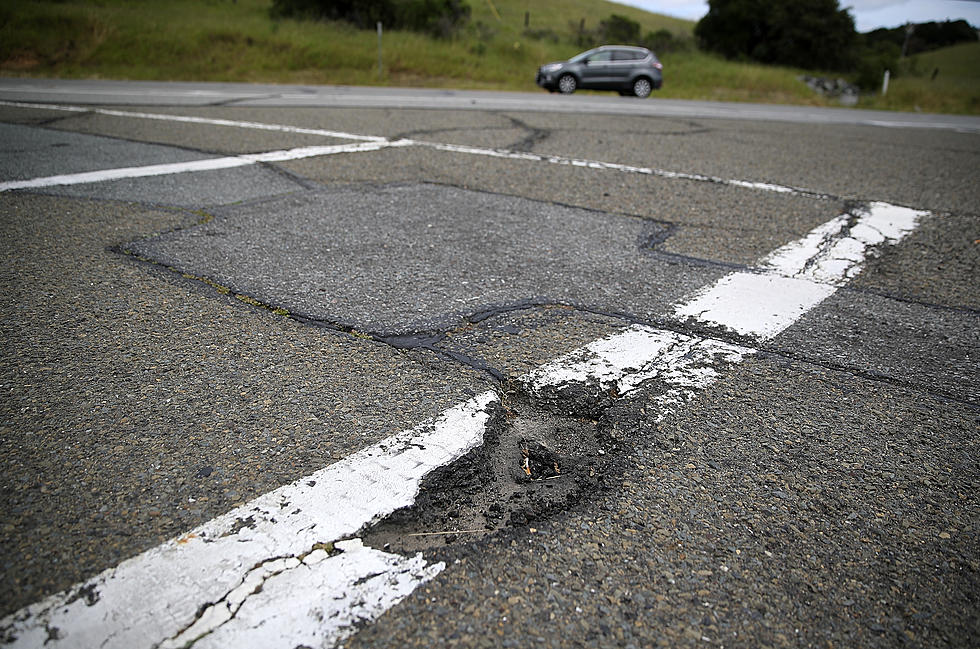
Louisiana Roads Ranked Among Worst: Here’s the Actual Cause
LAFAYETTE, La. (KPEL News) — Louisiana drivers navigate some of the worst road conditions in the country, and the causes run deeper than budget decisions or political will. The deterioration is rooted in engineering challenges unique to the state’s geography, compounded by extreme weather cycles and a funding structure that has lost more than half its purchasing power since 1990. Understanding why the roads are bad — and why they stay that way — requires looking at all three problems at once.
Louisiana has some of the worst roads in America. The American Society of Civil Engineers gave Louisiana’s road infrastructure a D in its 2025 report card. Bridges earned a D+. The state’s overall infrastructure GPA came in at C-, an improvement from the D+ the state received in 2017, though ASCE noted roads “continue to deteriorate.” Nearly half of Louisiana’s major roadways are in poor or mediocre condition. Traffic has grown 13 percent since 2017. Congestion and wasted fuel cost residents and businesses $4.1 billion every year.

Those three problems (geology, weather, and funding) feed each other. The ground that makes construction expensive also makes storm damage worse. The storms that destroy roads faster than they can be repaired make the funding gap harder to close. And the funding gap, now measured in the tens of billions, leaves the state unable to build to the engineering standards the terrain actually requires.
Louisiana’s Ground Was Never Made for Roads
The most persistent challenge in Louisiana road construction is not surface-level deterioration. It is what lies beneath the pavement.
Norma Jean Mattei, Professor of Engineering at the University of New Orleans and a past president of the American Society of Civil Engineers, explained the core problem, noting “The Mississippi River created a giant alluvial plain, so we’re not blessed with bedrock here.”
Road construction in most states begins with a stable substrate. In Louisiana, engineers must first engineer the ground itself before a road can be built on top of it.
A peer-reviewed geotechnical study published in Discover Soil describes the challenge plainly: southern Louisiana is dominated by soft, underconsolidated, organic soils with high water content and low shear strength. Those conditions compromise the stability and bearing capacity of any foundation, including the roadbed under a highway. Engineers can’t assume standard load capacity when building in Louisiana because the subsurface can shift dramatically from one block to the next.
This is why roads across south Louisiana are prone to subsidence, the gradual sinking of the ground beneath the pavement. In areas like New Orleans, subsidence happens at multiple layers at once: shifting faults, dewatering of soft rock, and the shrinkage of organic material in the soil. The resulting cracked, heaving, and uneven pavement is not necessarily the product of poor construction. It reflects the ongoing movement of the ground beneath a road that may have been built to standard when it was laid.
Thermal expansion compounds the geological challenge. Mattei has noted that Louisiana’s extreme summer temperatures force asphalt and concrete to expand. When that expansion cannot occur evenly, because the underlying substrate has shifted or because the material has already been stressed by moisture, the surface fails. Concrete slab buckling in midsummer is a direct result of this dynamic, and it occurs even on roads that were properly engineered at the time of construction.
Rain, Hurricanes, and Flooding Accelerate Everything
Weather is the accelerant in Louisiana’s road deterioration cycle. Each flooding event, hurricane season, and extended heat period causes measurable structural damage that compounds existing deficiencies.
Researchers at the Louisiana Transportation Research Center studied what repeated flooding does to pavement at the structural level and found that flooded sections performed significantly worse than comparable non-flooded roads. Heavy rain saturates the soil and base layers under the pavement, cutting their ability to bear weight. When that saturation happens repeatedly across South Louisiana, the damage stacks with every storm.
Hurricane storm surge presents a distinct category of damage beyond rainfall flooding. Surge does not merely flood road surfaces. It saturates the subgrade, undermines embankments, and deposits debris that traps moisture against pavement for weeks after a storm passes. Louisiana has experienced enough major hurricane seasons in the past two decades to establish a pattern: roads receive partial repairs after one event and sustain new damage before those repairs are complete.
NOAA records show southeast Louisiana is experiencing relative sea level rise at three feet per century, a combination of global sea level change and the ground sinking beneath it. Since the 1930s, the state’s coast has lost nearly 2,000 square miles of land, primarily marshes. Roads in low-lying areas face flood threats that didn’t exist when they were built, because the elevation that once protected them is gone.
Heavy Trucks Chew Through Pavement at a Rate Passenger Cars Can’t Match
Louisiana is a major energy, agricultural, and shipping state, and its highway network bears the freight burden of all three industries simultaneously.
According to a U.S. Government Accountability Office report, one fully-loaded 18-wheeler causes the same pavement damage on an interstate highway as roughly 9,600 passenger cars. Louisiana’s ports in New Orleans and Baton Rouge, its petrochemical corridors, its agricultural supply chains, and its offshore energy logistics push a volume of truck traffic onto major highways that far exceeds what the pavement was built to handle over a normal maintenance cycle. DOTD is running a road network being consumed faster than it can be replenished.
Louisiana also manages a disproportionately large state road system. According to a Pelican Policy analysis, 27 percent of Louisiana’s road miles are state-owned, against a national average of 19 percent. DOTD carries a larger maintenance obligation per dollar of revenue than most state transportation departments. Louisiana ranks fourth nationally in total bridge deck area, with five of the eight longest highway bridges in the world. Bridges cost far more to maintain than flat road surfaces.
The Gas Tax Stopped Working Over 30 Years Ago
Every engineering problem listed above has a funding solution. Louisiana doesn’t have the money to apply any of them.
The state’s primary funding mechanism for road construction and maintenance is a gas tax last raised in 1990, when a constitutional amendment approved by voters in 1989 added 4 cents to an existing 16-cent levy, bringing the total to 20 cents per gallon. That 4-cent addition funded the TIMED infrastructure program, a package of projects that has since wrapped up. DOTD’s own analysis shows that 20-cent tax, after inflation and vehicle fuel efficiency improvements, now carries the purchasing power of about 7 cents per gallon.
According to ITEP, the eroding purchasing power of Louisiana’s gas tax cost the state an estimated $8.3 billion in foregone revenue between 1990 and 2016 alone. Restoring it to 1990 purchasing power would require an increase of 14 to 19 cents per gallon. Twelve separate attempts to raise or restructure the motor fuel tax were introduced in the Louisiana Legislature between 2015 and 2021. None passed.
The ASCE puts the current project backlog at $24 billion, compounded by aging equipment, staff shortages, and limited maintenance funding. Louisiana pulled in nearly $6 billion in federal Infrastructure Investment and Jobs Act money over a five-year window, roughly $1.2 billion per year for transportation. DOTD Secretary Shawn Wilson was direct about the math when the IIJA passed: “We have a backlog of $15 billion in road and bridge repairs that will never be eliminated with the current gas tax.” That was 2021. The backlog has grown since.
Federal investment at that scale represents meaningful progress, but it addresses a fraction of the documented need and does not alter the underlying structural funding problem.
Among southeastern states, Louisiana ranks in the bottom three for per capita road spending. The state has 61,300 miles of public roads. Nearly half of major roadways are in mediocre condition. Louisiana drivers absorb that shortfall directly, through vehicle wear and repair bills. A 2021 TRIP report put the extra vehicle operating costs from rough roads at $667 per driver per year statewide, covering accelerated depreciation, repair costs, increased fuel consumption, and tire wear.
What It Would Actually Take to Fix This
Engineers and transportation policy analysts have been consistent about the conditions necessary for meaningful improvement.
On the funding side, the viable options include raising the gas tax and indexing it to inflation so its purchasing power does not continue to erode, restructuring the revenue mechanism toward mileage-based user fees as electric vehicle adoption reduces gas tax collections, or continuing to rely on periodic federal infusions that address portions of the backlog without resolving the structural deficit. Pelican Policy analysts have also recommended that the state reduce its maintenance obligation by transferring certain locally-traveled roads to parish jurisdictions, which would allow DOTD to concentrate resources on the state highway system it is best positioned to maintain.
On the engineering side, road construction in south Louisiana is more expensive per mile than in most other states by design. Proper subgrade preparation, deeper drainage systems, more frequent inspection cycles, and materials specified for both thermal stress and prolonged saturation all cost more upfront. The alternative — building to lower specifications to reduce initial costs — produces roads that require more frequent and more expensive repair, a pattern Louisiana has followed for decades.
The ASCE noted in its 2025 report that DOTD is pursuing efficiency improvements, including drone inspection, GIS mapping, and intelligent transportation systems to make better use of constrained maintenance budgets. Those tools can improve how dollars are spent. They cannot substitute for adequate revenue.
You May Also Like...
- I-49 Improvements Begin In 2026, Enhancing Travel From I-10 To St. Landry
- Louisiana Lawmakers Push DOTD to Move on I-49 Lafayette Connector
- Tired of Louisiana's Potholes? Here's Why Our Roads Are So Bad
6 Car Issues That Will Get You Pulled Over in Louisiana
Gallery Credit: Joe Cunningham

More From Talk Radio 960 AM